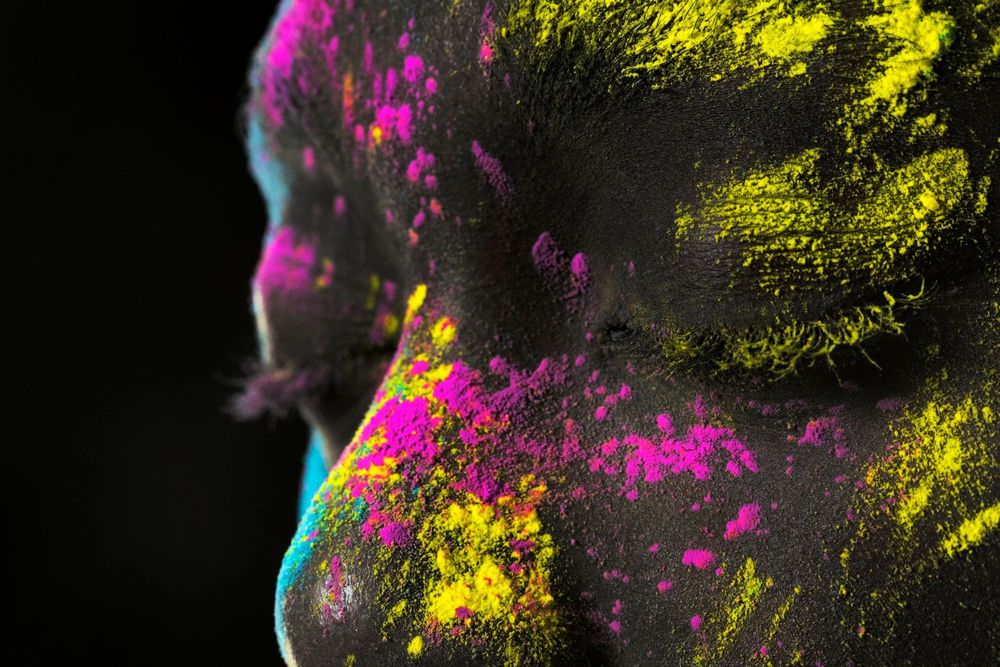
Does your website look too much like your competitors'? Will your stand at the next trade fair be yet another screen with a looping video? Generative art is the most direct way to stop your brand from looking like a template: a system of code and AI that creates unique, living visuals that always stay true to your identity.
In 2024 generative art was associated almost exclusively with NFTs. In 2026 brands, museums, events and online stores use it to achieve something very specific: getting people to stop, look, interact and remember. In this article we explain what it can do for your company, which technologies we use, how we work and how we quote it, so you can request a proposal knowing exactly what to expect.
In short: generative art turns your brand into something that moves, reacts and never repeats itself: websites, events, retail and campaigns with thousands of unique pieces. At MiTSoftware we design it, build it and quote it in phases, starting with a free 30-minute consultation. Book your consultation here →
Does your brand need generative art? 5 clear signs
If you recognise two or more of these situations, it is worth a conversation:
- Your website does not stand out. It works, but it could belong to any competitor and time on page is low.
- You have an event, a trade fair or an opening coming up and want something that draws visitors and creates content for social media.
- Your campaigns need many variants (by city, segment or product) and producing them by hand is slow and expensive.
- You have interesting data (sales, impact, sustainability) that nobody looks at because it is presented in tables.
- You want your brand to be seen as innovative without falling into the "generic AI" look everyone has already seen.
Did any of these sound familiar? Tell us about your case in one sentence and we will tell you whether it makes sense: write to us or message us directly on WhatsApp.
What generative art is today (and why it works for brands)
A generative work is a system, not an image. We design rules (geometry, physics, colour, motion, input data) and the system produces different results every time, always within your visual identity. That is what makes it so effective: people come back because they never see exactly the same thing twice.
Three changes have turned it into a business tool:
- Generative AI has joined creative coding. A system can build the composition with its own rules and use an AI model to texture it or adapt the style to your brand.
- The browser is now a powerful canvas. With WebGPU, a website can display real-time visuals that used to require a native application.
- The format has reached major institutions. Dataland, the AI art museum led by Refik Anadol, opened in Los Angeles in June 2026 with an immersive installation created from nature data (Monocle). What is in a museum today is what your brand's customers will expect tomorrow.
What generative art can do for your company
These are the projects we are asked for most and the business result each one aims for:
- Websites and landing pages people remember. Interactive backgrounds and elements that increase time on page and brand recall, optimised so they do not slow the site down. Goal: more conversion and less bounce.
- Installations for events, trade fairs and retail. Screens or projections that react to visitors. Goal: more traffic to your stand and content people share.
- Campaigns with thousands of unique pieces. Creatives personalised by segment, city or customer, generated from a single system. Goal: more variety in less time and at a lower cost per piece.
- Generative visual identity. A logo or graphic system that evolves with the season, the time of day or your data. Goal: a brand that feels alive and innovative.
- Artistic data visualisation. Annual reports, sustainability reports or brand dashboards that people actually want to look at. Goal: figures that are understood and shared.
- Digital collectibles and loyalty. Limited editions, tickets or unique rewards for your customers. Goal: more engagement and repeat business.
Do you have an event, a launch or a website redesign in the coming months? This is the best time to plan it, because the visual exploration phase takes just a few weeks. Request your no-obligation proposal →
Generative art technologies in 2026: what is now possible
Technology has advanced more in the last 18 months than in the previous decade. This is what we can bring to your brand today, and what two years ago was unthinkable or extremely expensive:
Real-time generative AI
With StreamDiffusion running inside TouchDesigner, a diffusion model transforms a live camera feed at dozens of frames per second. A visitor steps in front of the screen at your stand and instantly sees themselves turned into a piece in your brand's style. With ControlNet we keep the person's shape and pose while the AI changes everything else.
Next-generation generative video
The latest video models (the newest versions of Veo, Runway, Kling and Sora) now produce clips with realistic motion, synchronised sound and camera control. We combine them with our own generative pieces for campaigns, retail screens or event backdrops.
An AI style trained on your brand
Using techniques such as LoRA on open models like Flux, with production pipelines in ComfyUI, we train a visual style from your assets: colours, textures, product, typography. The result does not look like "generic AI", it looks like your brand. And because the pipeline is yours, you can generate new pieces whenever you need them.
WebGPU and Gaussian Splatting in the browser
WebGPU now works in the major browsers and lets a website display particles, simulations and shaders in real time with native-app quality. Three.js has also added a native Gaussian Splatting renderer for WebGPU (Radiance Fields): you scan a real space or product with your phone and turn it into a photorealistic, navigable 3D scene on your website, which we can then "dissolve" or transform with generative effects.
Touchless interaction and reactive pieces
Computer vision (hand, body and face tracking), depth sensors, sound and live data make the piece respond to whoever is looking at it. The same applies to your website: the visual can react to the cursor, the scroll, the time of day or the weather in the visitor's city.
AI agents that produce variants
We connect the generative system to AI agents and automations (for example with n8n) that read your catalogue or CRM and automatically generate the variants for each campaign, ready to publish.
Provenance and content credentials
Every piece can carry Content Credentials (C2PA): signed metadata that shows how it was created. It is the cleanest way to meet the transparency required by European regulation and to protect your brand against copies.
You do not need to master any of this: we choose the stack based on where the piece will live and explain it to you in business terms.
Want to see what these technologies can do for your brand? In the free consultation we show you examples applied to your sector. Book your consultation →
How we run a generative art project
We know that what holds people back most is not knowing what happens after they get in touch. This is the process, step by step:
- Free 30-minute consultation. You tell us your goal and where you picture the piece. We tell you whether it makes sense and which approach we recommend. No commitment.
- Written proposal. Within a few days you receive the scope, technologies, timeline and a phased quote.
- Visual exploration. Several generative sketches so you can choose the aesthetic direction before investing in production.
- Proof of concept. A working prototype on the real medium (web, screen or projection).
- Production and deployment. Full development, integration with your website or systems, installation and support.
If the piece is part of your website, our web development team integrates it; if it feeds campaigns, we connect it with our AI for digital marketing services.
How much generative art costs and how we quote it
There is no catalogue price: an animation for a landing page and an interactive installation for a trade fair are very different projects. What we do guarantee is a clear quote with no surprises:
- The first consultation is free.
- Fixed-price exploration and proof of concept, so you can validate the idea with a limited investment.
- Production at a fixed price or as a bank of hours, depending on whether the scope is defined or the piece will evolve with your campaigns.
- Recurring costs quoted separately (AI models, cloud GPUs, licences), so you know what you pay once and what you pay every month.
To give you a quick estimate we only need 4 details: where the piece will be shown (website, event, store, campaign), the date you need it by, whether it must be interactive and, if you have one, a visual reference you like. Send them to us and we will reply within 24 hours.
Want to know what your idea would cost? Send us those 4 details and we will give you a real, no-obligation estimate. Request a free estimate →
Generative art and the EU AI Act: your project, free of legal risk
Since 2 August 2026 the transparency obligations in Article 50 of the EU AI Act apply: synthetic content must be detectable and deepfakes must be disclosed; for clearly artistic works the regime is lighter, but it does not disappear (AI Act Explorer).
Many creative agencies overlook this. We do not: we document which parts are produced by AI, add provenance metadata when the medium allows it and review the rights to the data and assets used. Your brand gains visibility without exposing itself to a legal or reputational problem.
Frequently asked questions
Is generative art the same as asking an AI for an image? No. An image made from a prompt is a one-off result that is easy to copy. Generative art is your own system that produces endless results consistent with your brand.
Will it slow down my website? Done well, no. We optimise the visuals for mobile and prepare a static version for devices that cannot run the full one.
How long does it take? The visual exploration and proof of concept usually take a few weeks. If you have a fixed date (an event, a launch), tell us on the first call and we plan backwards from it.
Do I need a clear idea before getting in touch? No. Many of our best pieces come from a conversation about the business goal. All you need to tell us is what you want to achieve.
Do you work outside Barcelona? Yes. We work with companies across Spain and in other countries; physical installations are planned with an on-site visit or setup.
Request your generative art proposal
Tell us what you want to achieve and where you picture the piece. In a free 30-minute consultation we propose an approach, the right technologies and a phased quote. No commitment, and a reply within 24 hours.
Prefer something faster? Message us on WhatsApp at +34 698 865 895 or call us on +34 938 235 149. You can also explore the rest of our artificial intelligence services.